

Most people who only know me in a professional setting don’t know I live with disabilities that aren’t immediately obvious. In spite of the issues I live with, I don't typically think about accessibility in software development. At least, not as often as I should.
But there was a post I read recently (not linked, for privacy) where someone shared their own disabilities and how tools like Claude Code have become a form of accessibility for them. They described a few of the symptoms and issues that they regularly deal with:
thinking through brain fog, losing context after breaks, and getting stuck because the effort of organizing the work is bigger than the work itself.
While I do recognize some of that in myself, the specifics aren't the point. In this case, what matters is the generalization. I've had to work with and through my own problems for many years. There are days when the work I love is right in front of me, but my body or my brain won't cooperate enough to let me reach for it.
So, I want to explore what that post gave a name to: not the usual Claude as a way to go faster, but agentic tooling as a form of accessibility.
Accessibility isn't just screen readers
When we say "accessibility" in software, we typically think about it from the perspective of the final product: image captions for screen readers, keyboard navigation for impaired motor skills, high-contrast themes for vision issues. These are all individually and collectively important, but the principle from which these tools are built is larger than all of them.
Accessibility is the work of removing the barriers between a person and the thing they're trying to do.
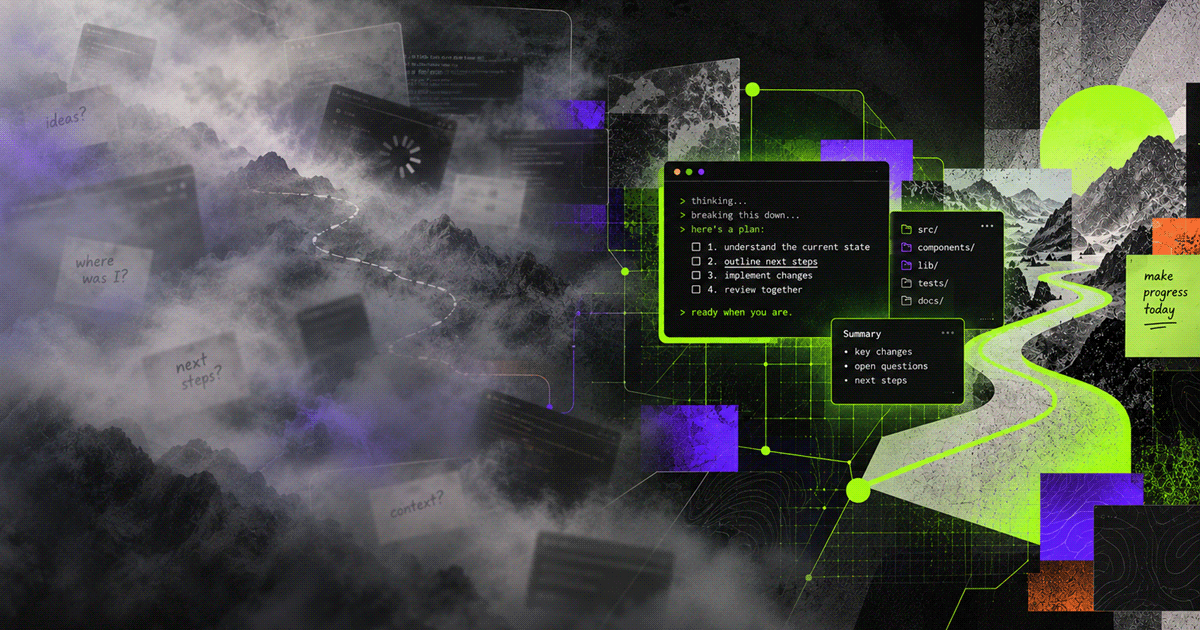
Sometimes accessibility is about vision or hearing, or motor control and the physical cost of typing and clicking all day. Sometimes it's about physical access, like an automatic door that opens and stays open, allowing someone through. And sometimes it's about cognition and energy: a fog that rolls in and makes a small task feel enormous.
The author of the post put this into perspective:
[Agentic tools] are not only about speed or output. For some of us, they help keep the door open at all.
However accessibility is implemented, it is fundamentally the difference between a person being able to reach a goal or not, regardless of the size, complexity or immediacy of the goal.
How does agentic tooling make software development accessible?
One way agentic tooling helps make software development accessible is the physical cost of the work. Writing code is a lot of typing and a lot of mousing—a lot of small precise movements repeated for hours. When I can describe what I want and have an agent draft it, the physical price of a task drops. I'm reviewing and deciding instead of grinding out every keystroke. This isn't free or universal, though. Agentic tools come with their own clicking and scrolling and reading, and for some people that trade isn't a win. But for some of us, on some days, it is.
Then, there's organizing; the post I read named this one, specifically:
Claude Code has been helpful for me because it acts like a second layer of memory and structure. I can brain-dump what I am trying to do, ask it to turn that into steps, have it summarize where we left off, or use it to reduce the amount of repetitive typing and context switching I have to do.
On days when the effort of organizing the work is larger than the work itself, having something else hold the structure is sometimes what lets me start at all. I can offload everything in my head into the conversation, ask for a plan, step away when I need to, and come back to a summary of where I left off instead of a cold, blank screen.
Another area where agentic tooling can help—and one that's often extremely difficult to explain to someone who hasn't lived it—is inconsistent energy levels. Some people work from a limited and unpredictable supply of energy. Some days it's high. Some days it's low. Some days it shifts hour to hour, minute to minute. However it manifests, working beyond capacity may be more than a one-time cost with a quick recovery. Overspending that energy can quickly turn into a deficit for tomorrow, the day after, the week after, and beyond. At times, a single day of over-expending can require a week or more of recovery.
When a tool lowers the cost of getting started, of the mechanical effort, and of keeping track of progress, it can move a task from "impossible today" to "possible today." This is the core of accessibility: not just a productivity gain that might come as part of this, but the ability to start, work on, or complete a task at all.
Keeping the door open
Most conversation about agentic tooling focuses on speed: how much faster, how much more, how much sooner. There isn't anything wrong with that perspective. But it isn't the only way to evaluate these tools.
From that post:
Has anyone else here started thinking of Claude Code less as a productivity boost and more as an accessibility tool?
I hadn't considered agentic coding tools that way until I read that post. What I realized, though, is that I'd already been using Claude in this manner. I've had some recent days where the starting point for work felt like it was locked behind a vault door. Claude opened the door for me and kept it open with little more than a few sentences and a pointer in the right direction. It let me move forward when I may have otherwise sat there for countless hours, trying to figure out how to get around the first barrier.
The starting line is not the goal
Accessibility isn't a "fix" for disabilities, and accessibility is not the goal, either. At best, it's the bare minimum for getting started, creating an environment that allows someone to move toward a goal.
Again, from the post regarding Claude as accessibility:
[Claude] does not fix the pain. It does not replace judgment. It definitely does not magically make programming effortless.
Critically, a coding agent does not offload responsibility from anyone. In my day to day work when I'm using a tool like Claude Code, I'm still responsible for the output. The code, documentation, and other artifacts that are created on my behalf must represent my best effort and understanding at the time. I'm not handing the work to an agent, looking away, and assuming it came out right. On a bad day, I get things into a workable state, then handle the review and understanding on a better day.
This is one of many perspectives on AI
There's no question that AI and agentic coding have improved my day-to-day work. On some days, an agentic coding tool is what lets me get any work done. And on other days, these tools have allowed me to complete tasks in mere hours that would have taken days without them. But, there's also no question that there are significant problems with AI. There are social and political issues that range from the loss of jobs to pollution and the environmental impact of water use, to name a few. We can't ignore the problems that AI has already caused and will cause if it's left unchecked. But we also can't ignore the real benefits that come with it.
For some people—myself included, at times—this technology and the new level of accessibility that it creates may be the thing that lets us move forward at all.
River Bailey is a Senior Software Consultant at Test Double, and has experience in building agentic workflows and plugins for solo and small team environments.