



Codified to enculturated: The accountability gap
In my previous post on codifying culture, I closed with a deliberate boundary:
- Deciding who you are and how you will operate
- Naming your principles
- Articulating your trade-offs
Cascading this into behavior is something different. It’s the slower, less legible change management work that is harder to declare “finished.”
The organizations I worry about most are not the ones that skipped codification. They at least have an honest problem to solve. The ones I worry about completed the workshops, published the principles, and now find themselves six to twelve months later unable to tell whether any of it stuck.
Principles exist. The language lives in documents. But decisions are still being made the way they always were. No one knows what to do next.
That uncertainty — the mid-transformation pause — is what this post is about.
Culture without accountability is decoration
Most organizations implement the first two of the three enculturation mechanisms that I described in my previous post and skip the third.
- They inject principles into existing rituals:
- Sprint reviews include a moment to ask whether work honors Outcome over Output.
- Retrospectives ask whether decisions this sprint reflected the stated trade-offs.
- Leaders begin modeling the principles in visible moments;
- A senior leader invokes the Launch Trade-Off to explain why a release was delayed.
But when I ask whether there is a structure for accountability — a mechanism to notice, name, and address moments when a principle is violated and nothing happens — the conversation goes quiet.
That silence is the gap. A principle without accountability is an aspiration. Aspirations do not change behavior at scale.
I call the full sequence The Accountability Arc: the three-stage progression from codification through activation through consequence. It is only complete when all three stages are operating:
- Codification names the principles and trade-offs with enough specificity to constrain decisions
- Activation embeds them in rituals and models them visibly through leadership behavior
- Consequence makes the principles real by ensuring their absence is noticed, named, and addressed
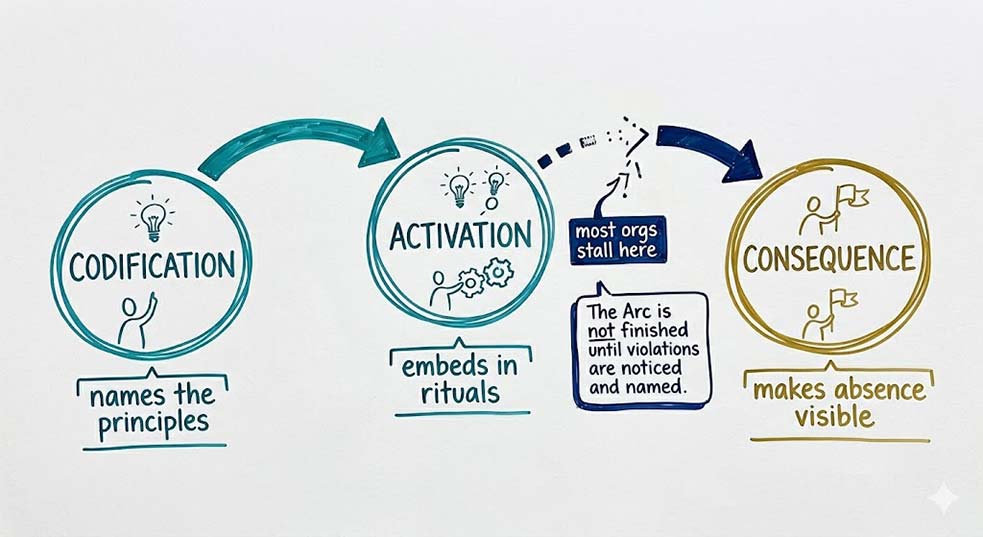
Most organizations stall between stages two and three, then wonder why the culture did not change. The Arc is not finished until the third stage is genuinely operating.
What behavior change actually looks like
Before you can measure behavior change, you need to name the specific behaviors you expect. This is where most measurement efforts break down first. Organizations reach for a survey or an engagement score when what they actually need is a behavioral specification.
Every principle in your codified culture predicts a set of observable actions. The work is to name them.
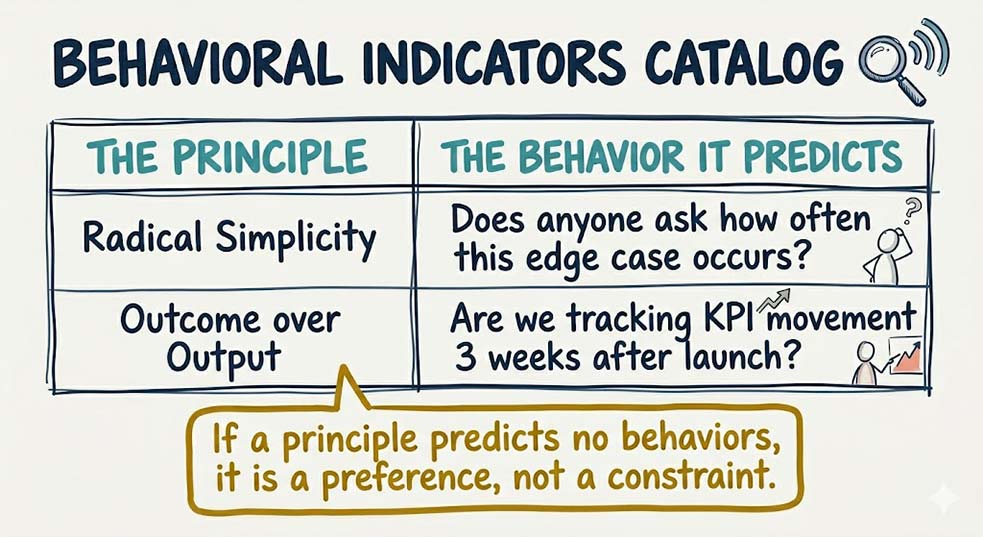
Take Radical Simplicity: We ruthlessly eliminate steps, data, or code that do not directly add value to the customer. The behavior it predicts is not a general preference for clean design. It is a specific decision-making pattern:
- When an engineer proposes a custom solution for an edge case, does someone ask how often that case occurs?
- When a process is proposed, does someone ask which existing step it replaces?
- When a feature request arrives, does the team ask which feature it makes redundant?
If those questions are being asked unprompted, by ICs, not just leaders, Radical Simplicity is taking hold. If they are absent, it isn't. The answers are less important than the action to ask these questions thoughtfully.
I refer to this as a Behavioral Indicators Catalog: a principle-by-principle translation of what each value should look like in practice.
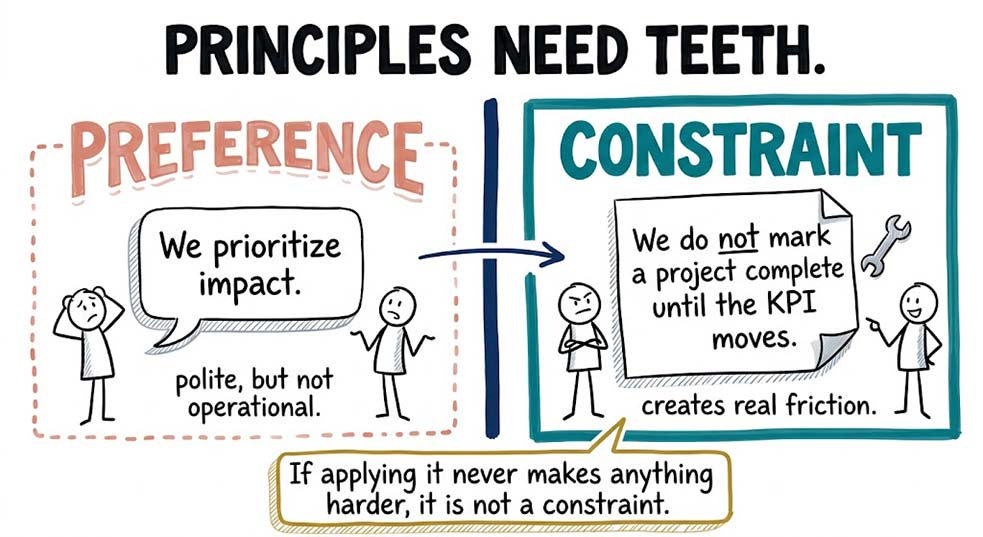
Not a values survey. Not an NPS score for culture. Specific, observable actions each principle predicts, and a lightweight mechanism for noticing whether those actions are occurring. A principle that generates no behavioral predictions is not a constraint; it is a preference. Preferences are polite. Constraints are operational.
Building the accountability structure
Here is where I push hardest with every client, because this is where the most discomfort lives.
When I say "accountability," leaders hear "punishment." They picture surveillance, catching people doing things wrong, distrust. I want to name that instinct directly, because its cost is the entire enculturation effort.
Accountability structures do not need to be punitive to be real. What they need to be is visible. The first question is not: "What happens to someone who violates a trade-off?" It is: "Who notices when a principle is violated, and do they say something?"
Visibility comes from three places.
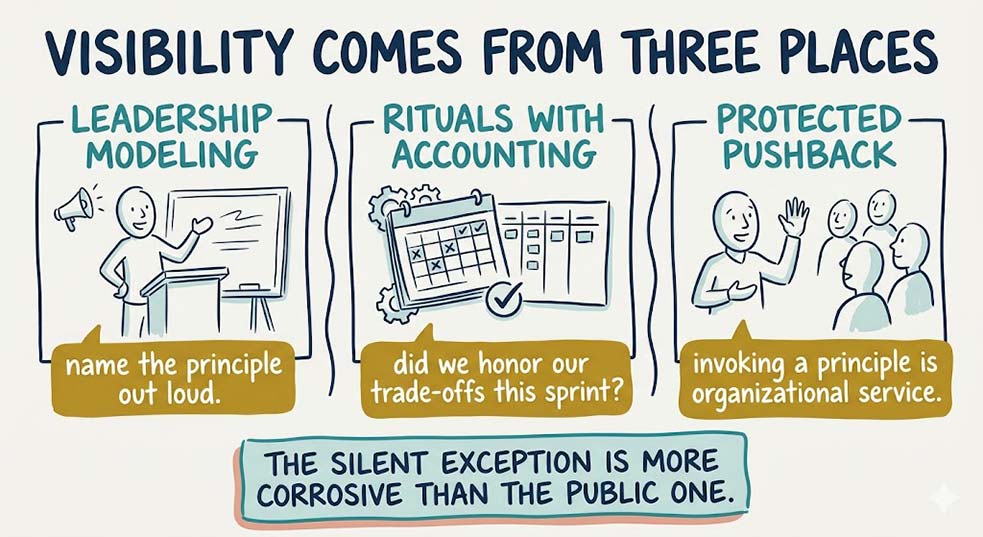
Leadership modeling in high-stakes moments.
When a senior leader makes a decision under pressure and names the principle it reflects, they are not just deciding, they are performing the culture for everyone watching. "I'm delaying this launch because our stated trade-off says quality over speed, and I want to be explicit about what that means in practice." That narration is accountability. Conversely, when a leader violates a stated trade-off without acknowledgment, the message to every team member is that the principles are conditional. The silent exception is more corrosive than the public one, because it forecloses the conversation.
Product rituals with built-in accountability.
Every retrospective should include one question beyond the standard format: "Did our decisions this sprint honor our stated trade-offs? Where did we deviate, and why?" The goal is not a perfect score. A team that says, "We deviated from Radical Simplicity twice; here is why," is enculturating. A team that says the culture is fine but cannot name a single instance where a principle constrained a decision is not. The question must be asked with enough regularity to feel normal, not ceremonial.
Principled pushback as protected behavior.
Codified culture is only real when an IC can say, "This request conflicts with our Scope Trade-Off; we'd be optimizing locally at the cost of global efficiency," and have that pushback welcomed rather than dismissed. If people who invoke principles get labeled as difficult, the culture calcifies. The accountability structure must send explicit signals, through how disagreements are resolved and through what gets recognized, that invoking a principle is an act of organizational service, not obstruction.
What to do when you cannot measure yet
The most common situation I encounter: the organization that wants to know whether the culture is working but has no baseline, no historical data, no obvious proxy metrics. My guidance is almost always the same. Start with stories.
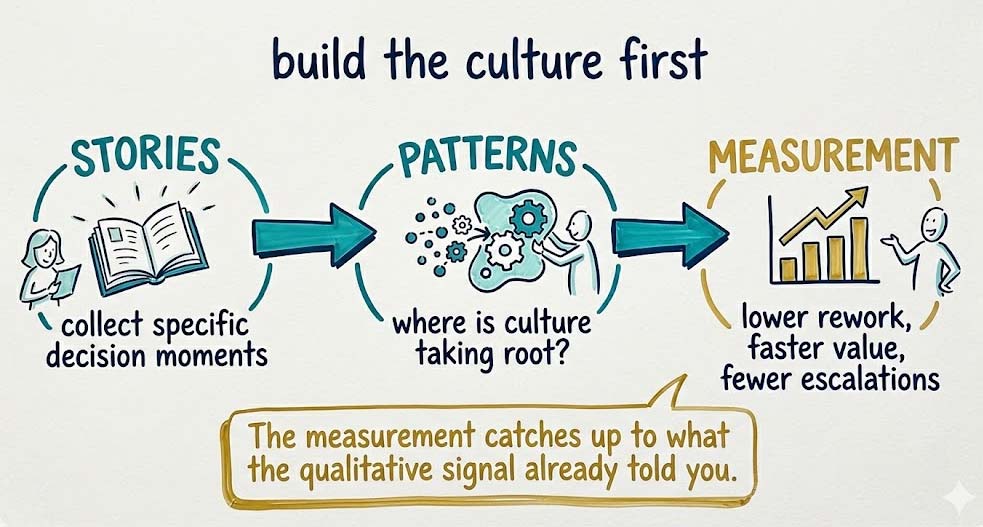
In the early stages of enculturation, the strongest signal is qualitative. Ask team members for specific decision stories, not surveys, not ratings, but moments where a principle showed up or where its absence was felt. Did someone invoke the Launch Trade-Off in a stakeholder conversation? Did a team lead use Outcome over Output to push back on a velocity-focused request? Collect those stories. Count them. Share them publicly.
The stories do two things.
- They show you where the culture is actually taking root, which is almost never uniform across an organization.
- They create social proof.
When teams hear that an engineer invoked Radical Simplicity to push back on a feature request and was thanked for it, they internalize that the culture is real and that using it is safe. Stories model behavior just as surely as principles do.
Over time, stories become patterns, and patterns can be measured. Teams producing the most principled-decision stories tend to show up later with better outcomes: lower rework rates, faster time to value, fewer escalations. The measurement catches up to what the qualitative signal already told you.
Build the culture first. Collect the stories. Let the measurement follow.
The finish line is further than you think
Culture transformation is not a project with an end date. It is an operating condition with a maintenance rhythm. The organizations that do this well schedule an annual review of each principle, asking
- Is it still creating useful friction?
- Have teams begun gaming it?
A second part of this review is of the accountability structures:
- Did leaders model the principles under pressure this year?
- Did the culture reveal itself to be conditional?
Marty Cagan's documentation of how the best product companies embed principles into daily decisions, not as wall posters but as operational constraints, is a description of what the Accountability Arc looks like when it is complete. Culture is not enculturated until it shows up in decisions, and it only shows up in decisions when people have both the language and the safety to invoke it.
The poet and philosopher David Whyte wrote that “the antidote to exhaustion is not rest. It is wholeheartedness.” The antidote to a culture that will not take root is not more principles. It is more courage: the courage to build consequence structures, to make the principles real by making their absence visible, to say out loud in the middle of a difficult decision, "This is what we said we believe. Let's honor it."
Codification is the starting point. Activation and accountability are how you finish.
Michael Toland is a Senior Product Management Consultant and coach at Test Double, and has experience in data and platform product management, product culture, and helping tie the tactics of strategic work to the day-to-day operations running our organizations.