

This is Part 4—the final article—of the Symptoms to Sources series, drawn from Test Double's original research report, Symptoms to Sources: Biggest Software Challenges for Healthcare in 2026.
- Healthcare software teams keep fixing symptoms: Real problems run deeper
- Legacy systems and delivery pressure: Symptoms healthcare tech teams keep treating
- The root causes healthcare teams overlook: Siloed data and misaligned priorities
- You are here: How to shift focus from symptoms to build stronger healthcare software systems
When we asked healthcare technology executives how they measure the success of their investments, operational efficiency was the most common answer (77%), followed by financial ROI (62%).
We originally expected to see user adoption and satisfaction or improvement in patient outcomes as more prevalent. But in the answers to another question—which business outcomes technology teams are being asked to impact—customer experience was the second most common answer at 16.7%, behind efficiency at 22.2%.

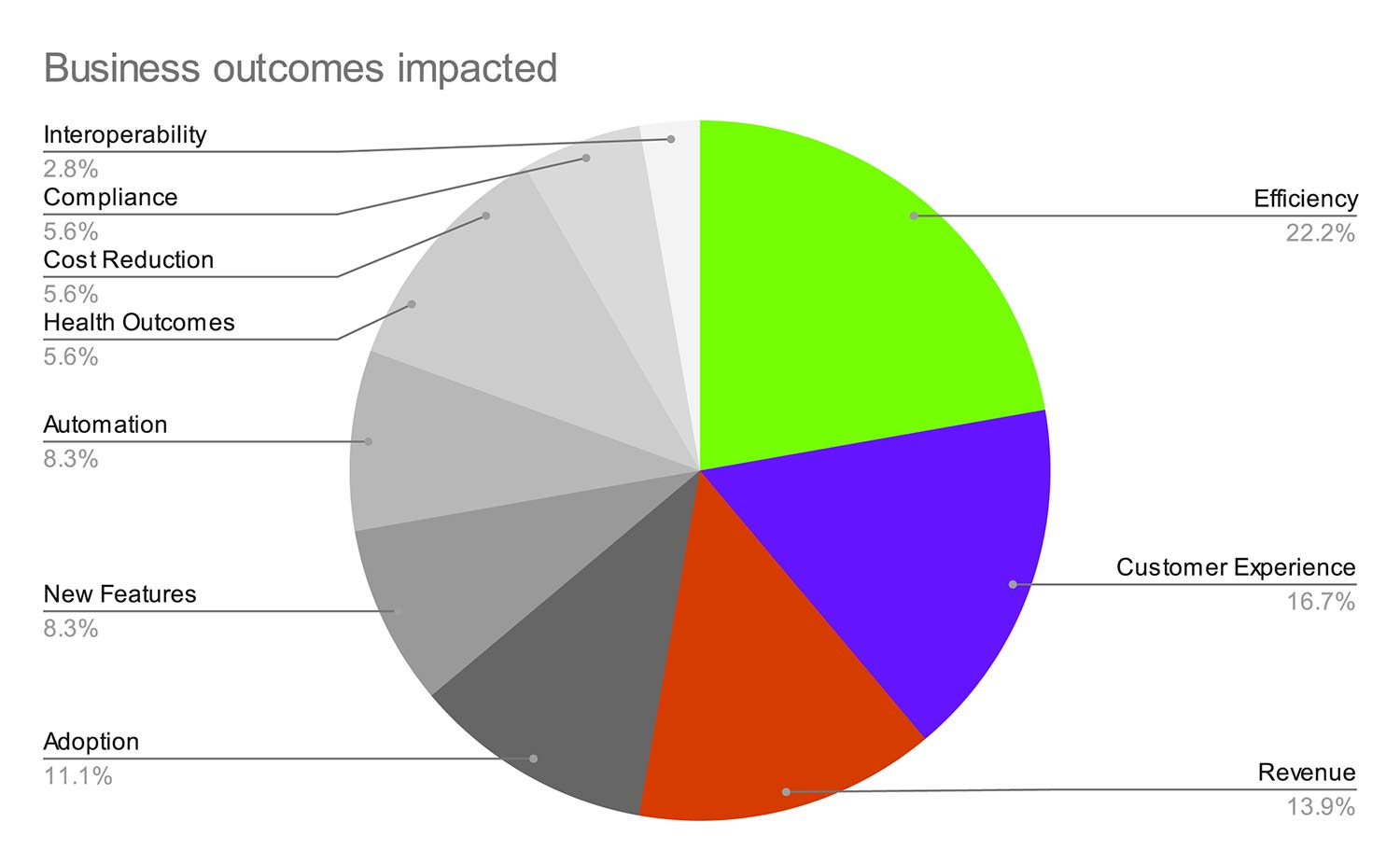
Perhaps technology teams struggle to draw a direct line between improvements within their function and end-result patient outcomes. In interviews, we heard that efficiency was important as long as it didn't deteriorate the quality of customer experience—frequently motivated by the desire to provide care to more patients with the same staffing and resources.
Nevertheless, this focus on efficiency and ROI can trap teams in a cycle of solving technical problems without addressing underlying issues. This surface-level approach yields only short-term resolution, burying longer-term problems.
A legacy modernization rewrite or a product launch to satisfy urgent requests from the board might rally the team in the interim. But when the dust settles and the challenges remain, your organization finds itself in the same position once again—facing the painful symptoms of its software problems and needing better processes and the right priorities.
So how do you tackle the root of technical and product problems rather than just treating symptoms?
A holistic approach to solving healthcare software problems
Test Double's team takes an objective, holistic approach: solving immediate needs and quick wins while reshaping the systems, culture, and alignment that sustain long-term organizational health.
These guiding principles offer a framework for product and engineering teams to move beyond short-term fixes and strengthen their organization as a whole.
Know the problem you want to solve before writing code
Before you can uncover a lasting resolution, you need to identify the right problem to solve. You need a clear goal.
Too often, the promise of technology and a focus on tools, platforms, or technical choices over larger strategy and outcomes create a myopic view. This challenge is even more pronounced in healthcare technology due to what Mike Berkman, CTO at ScriptDrop, calls the "relative complexity of the problem space."
"You can find yourself advocating for something that's going to miss the mark. It's really hard to get one person or a group of people to fully wrap their heads around the entire problem. There's so much nuance, there's so much complexity. It's really difficult."
— Mike Berkman, CTO at ScriptDrop
Without clarity and hypothesis validation, you don't know the problem that needs solving or where to direct your efforts long-term. You make assumptions—leading to wasted effort, overspent budget, or added complexity and risk. You miss the market for what customers actually need.
Consider a team that decides to replatform to modernize the digital front door. If the goal is to make it easier for patients to schedule appointments and access care, you'd invest in a streamlined portal, self-service workflows, and an improved mobile experience. But if you're trying to reduce clinician burden, you'd focus on integrating workflows, automating data entry, and improving EHR integration.
Each path is a different investment with its own tactics and strategies. "You can go on a journey, and you'll get somewhere eventually, right? But, is it the right place in the end?" says Jen Tedrow, Director of Product Management at Test Double. "If you know where you're going, you can align your product strategy, execution, and tactics accordingly. Once you put that clarity and focus in place, then you can execute much more effectively."
Avoid the wrong path by focusing your team on solving a problem rather than implementing a solution. Set aside the feature priority list and focus on business needs, specific personas, their problems, and the value you need to deliver.
This requires a consulting approach that doesn't take technical problems at face value but first assesses systems, processes, and culture—then moves quickly to tackle the holistic problem.
Test Double leads from a value-based discovery perspective, combining experimentation, data analysis, and customer research to validate assumptions and outcomes before committing to one path or writing a line of code. This approach requires more upfront thinking and thoroughness, but it mitigates risks, prioritizes cost savings, and increases confidence that time and resources will yield a meaningful outcome.
It's not output-based thinking. It's outcome-based thinking—which requires clear strategy and accountability as a team. That's why Test Double also focuses on building not only great software but also great teams.
Examine the system within its environment
Shifting from treatments to cures—real value over hyper-delivery schedules—requires taking the time to examine the system within its environment.
It's not seeking bandage fixes through isolated treatments. It's holistic problem-solving to cure root cause deficiencies within the organization. "Solutions have more to do with decision-making, organizational structure, and protocols than with tech prowess," said Doc Norton, Vice President of Delivery at Test Double. "Process improvements lead to software improvements and better business outcomes."
The cure begins by aligning your organization around shared outcomes: your North Star. The North Star becomes the "why" for your teams to connect their actions and priorities to higher business goals.
When product, engineering, and design teams all work with the same North Star in mind, it prevents competing priorities or feature-for-feature's-sake development from derailing progress.
By starting with the desired outcome, the North Star framework enables teams to drive customer value and commercial results. It requires understanding the goals, tactics, and inputs that drive the North Star metric—leading and lagging indicators of commercial success.
"The North Star framework is a very valuable and effective technique to remind large numbers of people not just what they are doing, but why they are doing it. It's hugely beneficial for prioritizing tasks and options, and getting everyone on the same page."
— Mike Doel, Engagement Partner at Test Double
This clarity makes it easier to tie feature delivery and roadmap priorities directly to business impact—adoption, retention, or efficiency gains—rather than output alone.
Invest in ongoing outcomes, not predetermined projects
Healthcare organizations typically budget to solve symptoms—like a line item for a legacy rewrite—rather than creating a cure.
Budget pressure frequently creates lasting commitment to the technology project and prioritizes delivery as the goal. Specify everything up front, build it, inspect it, call it done.
Instead, healthcare teams need a phased approach to deployments and migrations: limit negative impact, iterate on customer feedback, and build more strategic development roadmaps.
This value-based approach invests in specific improvements to deliver value, then constantly evaluates the return to either continue investing down that path or pivot to a higher-value one.
This changes the entire system. It incentivizes your team to vet initiatives and craft code more flexibly, shifting focus to incremental delivery of value, learning, and adjustment. Even "failed discoveries" become wins because they quickly reveal dead-end paths or lower-impact initiatives.
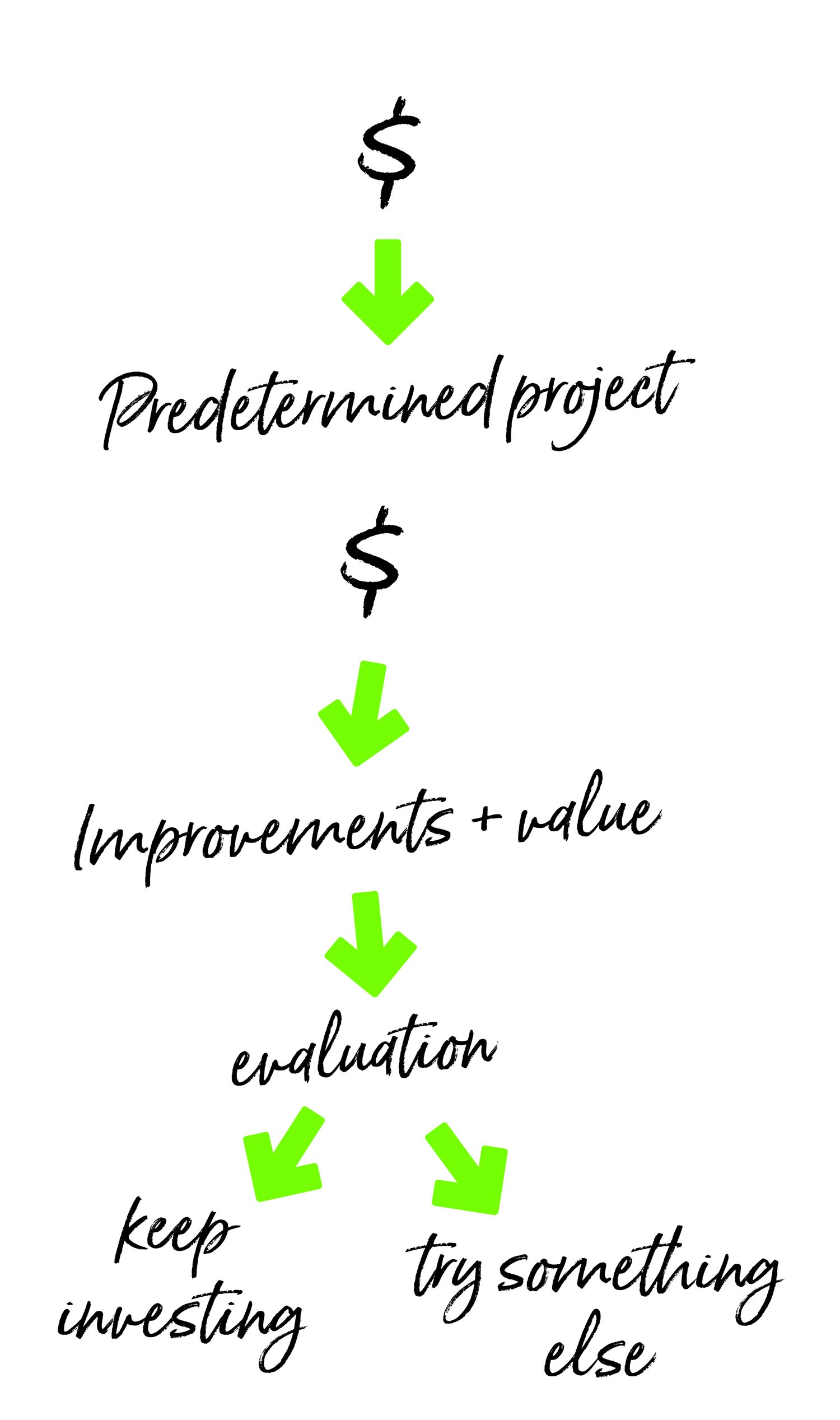
With this data in hand, your engineering or product team doesn't have to wait to complete a large-scale project to find out it's the wrong path months down the road. They can reinvest their time and budget where it counts.
At Test Double, we recommend prioritization methods like Weighted Shortest Job First, the Desirability/Viability/Feasibility framework, Assumption Mapping, and Value Proposition Canvas. These processes help teams and leadership identify the most valuable priorities and achieve internal alignment.
From there, we champion continuous discovery and ongoing customer input. Rather than executing a pre-suggested solution or forcing product teams to work as a feature factory, these approaches validate that initiatives are truly solving problems for end users and customers—which can only benefit the business.
It ensures you are not only building the thing right, but also building the right thing.
How healthcare leaders can solve software problems at the source
The behavioral shift from solving symptoms to rigorously pursuing outcomes isn't easy. Most teams find themselves building the plane as they fly it, balancing immediate demands with long-term modernization goals.
When your engineering or product team feels the pressure of these deeply rooted issues, you have a few options.
You can continue through the status quo—keep launching another product or executing another rewrite until the same problems rear their heads again.
You can attempt to address deeper, internal change management on your own—a massive undertaking without an experienced partner to guide the process.
The best option, and the only one that leads to lasting change: solve the surface-level problem by addressing the root cause. This often means bringing in an external partner with the experience and objectivity to uncover issues internal teams may overlook.
Our survey findings echoed this: access to specialized expertise is the main factor for seeking out external vendors on tech projects (54%), followed by cost and budget (46%) and speed and time-to-market (38%).
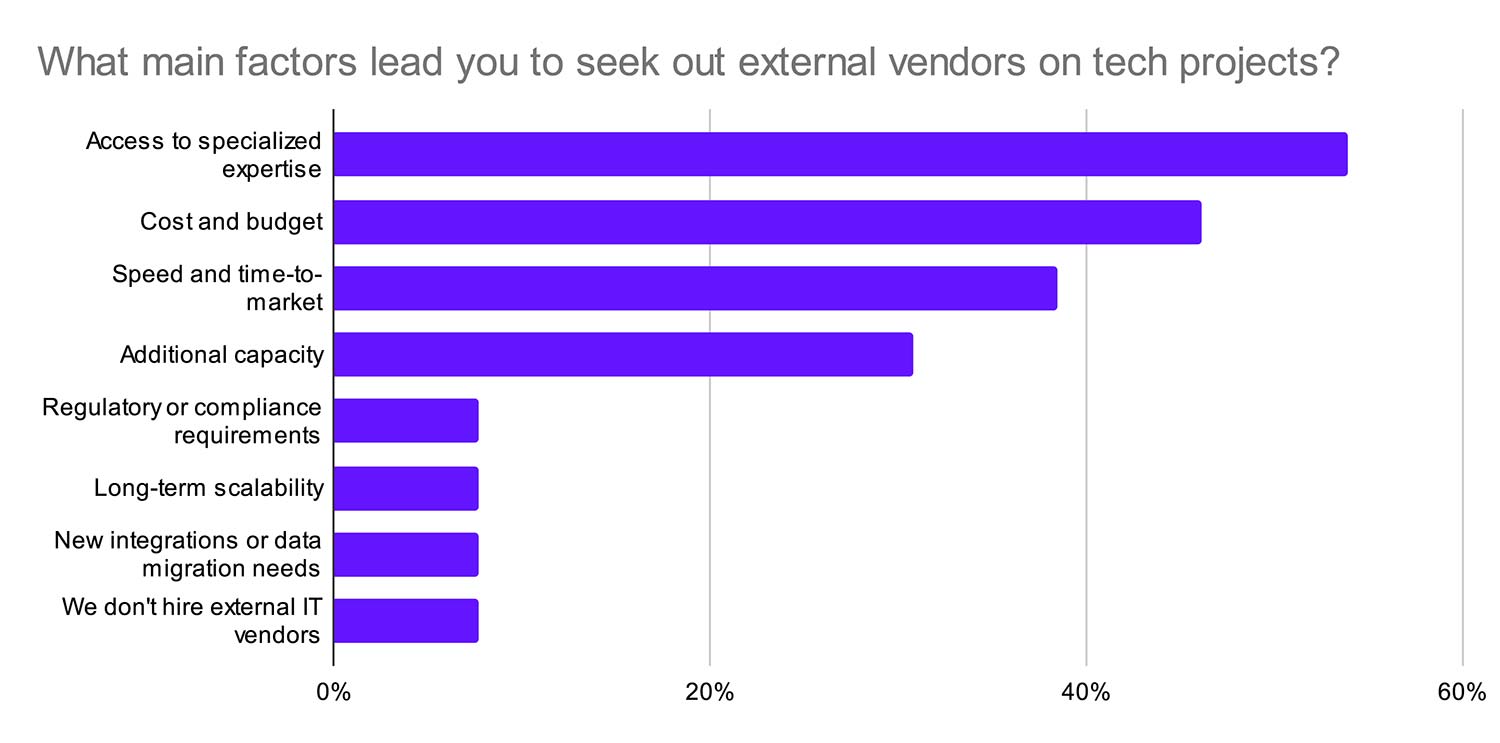
Cost and budget was also cited by 46% of respondents as the top reason for bringing a project in-house. This suggests that external investments are all about finding the right partner—one who takes a holistic approach to driving meaningful change and outcomes, not just filling seats.
The right partner doesn't fix surface-level tech problems and move on. A transformational software consultant goes deeper to align people, processes, and strategy. It enables your team to lean on experienced practitioners who have solved these same challenges for different customers and contexts and can apply a wider array of learnings to help your team get to the root cause.
It's only in solving the root cause that teams prevent the same problems from resurfacing and build a more secure foundation for innovation and growth.

Your roadmap: four steps to solving for outcomes
If you're not sure where to start, consider these four steps your roadmap on the journey from symptoms to meaningful improvement.
Step 1: Audit past experiences
Think through previous technology initiatives, particularly those that needed multiple attempts to get right.
Look for deeper issues: persistent problems, internal misalignment, scope or budget creep. Ask yourself: Should you have brought more voices to the table? Was the voice of the customer overlooked? Was discovery skipped? Was speed prioritized over quality? Was the team more focused on outputs or outcomes? Did bottlenecks strangle decision-making? Were timelines realistic and resources available? Were goals grounded in business need or born out of vague trend chasing?
Reviewing why past efforts succeeded or failed prevents wasted cycles and avoids repeating history. It also prepares you to give an external partner critical historical context and align teams on a better path forward.
Step 2: Map current capabilities and organizational readiness
Map out the current delivery environment: legacy systems, integration points, security and compliance requirements, and vendor or partner dependencies.
You're solving multifaceted technology problems and removing foundational roadblocks—not just addressing symptoms. Start by understanding the technical ecosystem and dependencies. Map bottlenecks and limitations to not just technical specs, but processes, priorities, metrics, and misalignment. Then approach the solution within the context of wider organizational needs.
Additionally, assess organizational receptivity. Are internal stakeholders prepared to collaborate on new approaches? Set the ground rules for honest conversations and reorient from outputs to outcomes—unearthing operational improvements along the way.
Step 3: Ask the right questions to find the right partner
A third-party partner helps you objectively identify and solve more meaningful problems than a single technical issue. But it takes due diligence to find a partner that fits within your team, asks the right questions, and brings both a technical and consultative background.
Questions to ask potential partners:
- Prioritization approach — How do you identify features and process changes that actually move business metrics, particularly when everything feels urgent?
- Healthcare domain experience — Describe your experience working with EHR systems. Do you understand how to manage PII, HIPAA, and PCI data?
- System reliability — Are you capable of building high-availability systems to support mission-critical services?
- AI and automation — What is your experience blending medical data with AI to create smarter recommendation engines and optimized workflows?
- Integration model — How does the partnership operate, who's involved, and how do you integrate into our team?
- Success measurement — How do you measure and report on success—outcomes or outputs?
- Knowledge transfer — How will you transfer knowledge and make us self-sufficient?
Choose a partner who fits well within your organization and prizes big-picture thinking—not quick fixes. Behind every surface-level challenge lies a broader opportunity to align people, processes, and technology around meaningful outcomes.
Solving for outcomes and building stronger health tech teams
Real progress in healthcare IT, product, and software engineering depends on solving root causes, not treating symptoms.
The landscape is shaped by uneven interoperability, slow patient engagement, and rising external pressures that demand smarter, more resilient, and secure systems.
For healthcare engineering and product teams, this means rethinking "surface-level problems" as the immediate fix. Instead, organizations need to dig deeper into business and human opportunities—clarify outcomes, break down silos, and build solutions that improve patient care.
If you're navigating complex IT, software engineering, or product challenges, we'd love to help. At Test Double, we combine deep legacy modernization experience with product thinking and AI adoption to solve the deeper process and cultural issues that lead to recurring problems—while solving your toughest software challenges along the way.
- Healthcare software teams keep fixing symptoms: Real problems run deeper
- Legacy systems and delivery pressure: Symptoms healthcare tech teams keep treating
- The root causes healthcare teams overlook: Siloed data and misaligned priorities
- You are here: How to shift focus from symptoms to build stronger healthcare software systems
Read the full report: Symptoms to Sources: Biggest Software Challenges for Healthcare in 2026
Know a leader in healthcare who cares about these things? Share the survey with them so we can expand our findings.
Cathy Colliver is Head of Marketing at Test Double, holds an M.B.A., and has expertise across strategy, brand, content, and marketing ops at startups, mid-size companies, and enterprise across software, healthcare insurance benefits, automotive, media, marketing solutions, and theatre.