

In the early days of search, there was a useful metaphor for search engine robots: web crawlers. While the internet vs the world wide web feels like an abstraction now, at the time it was still new(ish) and superbly relevant.
The web metaphor spoke to the interconnected links that built the structure. Hyperlinks stitched the fabric of the internet together. Web crawlers were then the seemingly automated things that traversed that web structure. And while that’s a long way from robots, we also called them (and still do) bots.
I remember an early SEO specialist at Humana explaining it with a further analogy—the web crawlers were like spiders. The paths that spiders took tracing connections made the paths stronger from an SEO perspective. I do not remember that SEO pro’s name (because I’m terrible at names), but the spider analogy was a great way to explain code-based processes that aren’t necessarily directly observable.
You could think of this as stitching to reinforce seams and paths. Yes, this is super stripped down, but we’re talking early search days. Spiders was a common search term then, though mostly replaced now with bots.
The spider concept stuck with me in my async brain, as concepts do. And it’s reemerged as I reflect back on that rapid epoch of the search + social + blogs trifecta, and also consider where we are now with the zero click + AI + TBD-but-it-will-be-wild epoch.
Worn seams can be restitched
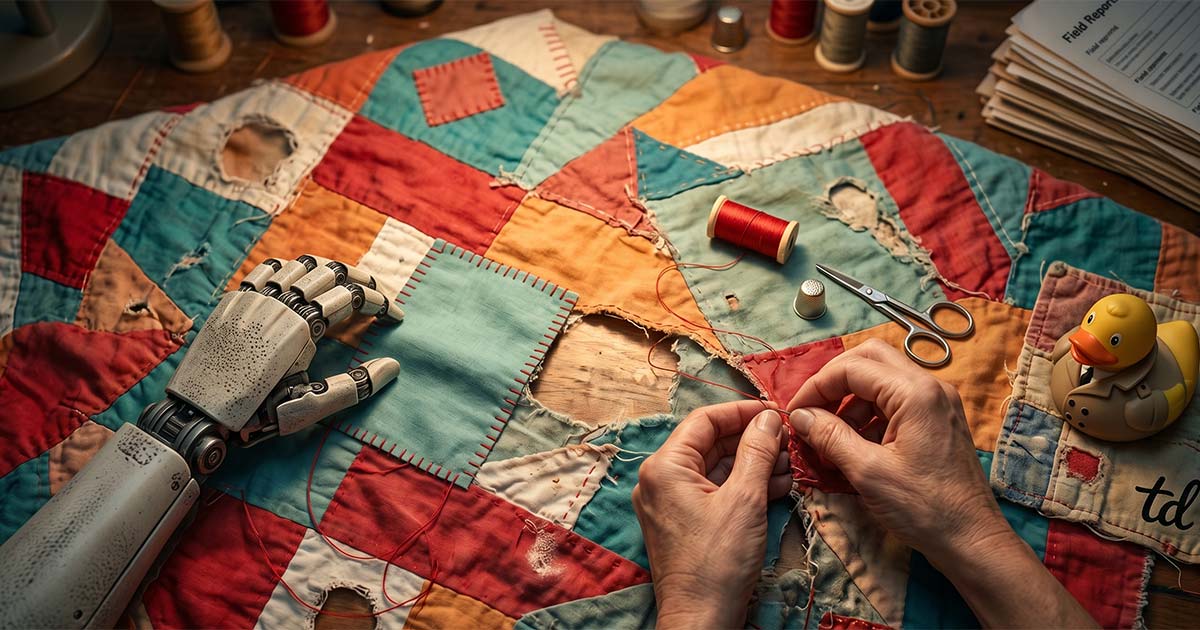
I can’t help but wonder if the internet is stitching itself back together again like some kind of well-worn quilt.
When you patch or restitch a quilt, you can reinforce old patterns and seams. But you can also introduce new patterns and little touches.
The internet has gone through the natural wearing down and cycles of patching that any system (especially a decentralized system) goes through.
Some patches of the internet have dry rotted. Some have unravelled. Others have evolved and been influenced by a consistent push to monetize just about everything. Many platforms created borders around their section of the quilt, fragmenting the pattern and the ways it can connect.
Yet human voices and authentic connections do still persist.
While AI is influencing seemingly everything in every discipline that can be consumed digitally, exact predictions remain foolish.
Emerging patterns might be deciphered, but we must also remember that this restitching is not exactly coordinated.
Everything everywhere all at once—with robots
Every individual person posting, consuming, interacting, programming, building, designing, writing, and orchestrating agents is involved in this restitching. And the AI tools being used to do all of these things are also involved.
Tools and robots are inextricably woven into the fabric of the internet. And always have been.
We’re living in the biggest quilting refurbishing party the internet has ever hosted.
I’m a practical optimist, so I would love to think that the restitched internet will be better in many ways.
- Renewed focus on community and connection
- Improvements in the usefulness of search
- New ways marketing can be helpful and valuable instead of super annoying
Others have written about the rewilding of the internet, to intentionally bring back the weird and wonderful. And the impending AI wildfire that will naturally level out the healthy from the unhealthy AI boom businesses.
That can still feel abstract. Like that’s something someone else will do or be involved in. Really, though, it’s all of us. Everything everywhere all at once.
AI tools and workflows can and will help restitch the internet. But humans will power the macro and micro decisions that determine the patches and stitching.
Every person who chooses to write from the heart vs only with AI.
Every developer who builds while focused on the customer.
Every business owner who tries to make things better.
Every marketer who focuses on what’s valuable to the audience.
All of us acting independently (and, increasingly, using AI tools to do so) are going to restitch the internet into this next epoch.
What are you doing to contribute?
Cathy Colliver is Head of Marketing at Test Double, holds an M.B.A., and has expertise across strategy, brand, content, and marketing ops at startups, mid-size companies, and enterprise across software, healthcare insurance benefits, automotive, media, marketing solutions, and theatre.